Wednesday, January 18, 2012

'Panic Station' Guest Review


(This game is being reviewed by Shokou Okano, member of the board game club.)

Panic Station, is a board game that falls into the science fiction, betrayal, and adventure category.  The minimum number of players is at least 4 players but is recommended to be played with 6 players.  The game is about a group of people called the Extermination Corps, sent by the government, to investigate the deadly virus that may infect the human population. Each player will control two characters, an android and a human, uncovering room by room searching for the virus hive to burn it, while cautiously keep a distance from each other, not knowing who has already been infected by a parasite.  As for the player who is the host, he or she must set out more parasites while infecting others to win the game. This game is a unique game which includes a traitor system, tactical plays, and an intense mind game between every single player. In my opinion, Panic Station, is a really fun game which has many great points, but it does has parts where it could be fixed to become a better game.

The points that make this board game a fun and intense game, is the traitor system and the mind game that plays a huge role in this game. As you start the game, everyone knows someone is the host of the virus, but they can’t tell who. This keeps everyone in suspense and focused on the game. After a few turns you can usually start to tell who is the host, because of their actions, face expressions, and cards. That is where the mind game kicks in and keeps the game flowing.  If you are a human it is crucial to listen and watch the game to pinpoint who’s human and infected. The host would have to take smart moves to trick others to fall into his trap and infect them. The host who can make the best poker face and fool others to believe him will infect everyone one by one. However others will start to notice some abnormal movements the host may take to infect someone, such as, moving onto the same tile to infect them multiple times.

Although this game works really well it does have some points that could be fixed. One point is that it is really hard for the host to infect others because it is like one against five in a six player game. And the humans would easily find out who is host if the host doesn’t infect someone quickly, which usually doesn’t happen. So a suggestion could be that you could increase one more host that would be infected later in the game if they draw a host card from a search pile. This would make the game much more interesting and to make it fair for the humans, additional gas tanks could be added so that the humans would have a higher chance to get them. Another point that could be adjusted is to allow a human to defend itself if it is armed with a gun. In this game the android the only character that could be allowed to shoot a weapon. However if your android is killed, the human is defenseless. That situation has happened to me a few times, and it frustrates me to find that I can’t shoot the suspected host with the fully loaded heavy gun right in front of me.

Putting all these points together, the good and the bad, I would rate this game with a 9/10. The reason is that the intense mind game and the traitor system works really well in this game and it is a perfect family or party game. Next time you bring your friends over to your house, take this game out of your shelf, or even buy this game to play with them, because you guys would be finishing the game, with enthusiastic faces, ready to explain how the game ended.

Tuesday, January 17, 2012

'BattleCON: War of Indines' Review


BattleCON is a card game that emulates the feel of a 2D fighting game similar to Street Fighter and King of Fighters (KoF). I have been looking for a good fighting game to introduce to my gaming group ever since I saw Yomi. Having playtested BattleCON for a few games, I can safely say that my search is almost over. BattleCON is the game that I've been looking for.

Gameplay
BattleCON revolves around 2 players fighting for a maximum of 15 beats (each beat is similar to one turn) on a platform consisting of 6 spaces. The platform is similar to the fighting ring. Whoever defeats the opponent's 20 hit points or has the most hit points at the end of the 15th round will be declared the winner. Players start by choosing one out of 18 characters in the print-and-play version (or 4 in the free version). With it comes a set of style and base cards. Styles represent the way the character functions, while bases are the common attack patterns, with each character having an additional base card that only the character posses.

During each beat, players pull up a style and a base card that forms an attack action. The cards are placed face down. Then, each player can choose to ante a token if they like. Tokens are character based, and not all characters have it. Once done, players reveal the cards they played. There are 3 things to consider: priority, range and power, in that order. Whoever has the highest priority goes first, where he/she calculates the range to see if the attack hits the opponent. If it does, then the power determines the damage the opponent takes. If the opponent has equal or more stun value than the damage taken, the opponent then calculates his range, followed by the damage dealt. If the opponent receives damage more than his stun value (or having no stun value), then the opponent is considered to be stunned, and the beat ends. Once the beat ends, the set of cards is placed in the discard pile, where 2 turns later, they return to the player's hands.

Great Card Combos
What makes BattleCON feel like a 2D arcade fighting game is the fact that the 2 sets of cards, the styles and bases, makes a great list of combinations (card combos). These combos can alter the way the battle goes. Although priority is a main factor in determining the winning beat, if the range fails to reach the opponent, then the player has wasted or lost that beat. To achieve that, some style and base cards include start of beat actions and start of activation actions, which usually allows the player to advance 1 or 2 spaces towards the opponent. As you can see, mixing and matching the style and base cards creates very interesting attack patterns. There's a card that allows players to evade attacks. Finally, there's a special card that mimics a super/finishing move found in fighting games. This card can only be used when the player's health drop to 7 or less. Once used, the card is removed from that game round.

Button Mashing Will Not Win The Day
Growing up in the arcade during the 1990s, I love playing the Street Fighter and King of Fighter series. One thing that makes me love KoF a lot is the fact that button mashing makes you go nowhere. Only with skills can one prevail in combat. BattleCON mimics that precisely. During gameplay, I found myself trying to think what my opponent will do, and to counter that, I decide the cards to be played. If chosen wrongly, I would have wasted that turn and probably get hit badly by the opponent. If played correctly, I would have played my cards well and my character would do damage to my opponent. That victorious feeling is immensely satisfying even though it's just 1 turn of the game. Playing with the same character numerous times allow me to see the character's strengths and weaknesses, while at the same time learn about my opponent's fighting pattern. This form of investment makes me feel like I am one with the character, with me as the mind and him as the body.

Huge Characters List And Variants
Currently, there are 18 character on the print-to-play version. If you pre-ordered the game before the end of December 2011, you will receive 3 more characters, making it a total of 21 characters to choose from. All characters are separated into 3 groups - basic, moderate and advanced. With basic characters, it's a bit easier to win battles. Moderate characters are recommended once players are comfortable with the gameplay. Advanced characters are hardest to use. In the hands of experts, any character can fight against anyone and still have a chance to win. It all depends on how good the player is at utilizing the strengths that the character has, and how well he can out-think his opponent.

The game also comes with a few variants such as arenas, tag team, character teams, multiplayer mode, ex and almighty duels (with more powerful and devastating actions), and 3 vs. 1 boss mode. I haven't had a chance to try those yet, but reading through it, I feel the designer has given us options that play similarly to the fighting games such as Tekken Tag Tournament. Even without these variants, BattleCON is already an amazing fighting game.

Conclusion
Once, my friend asked me," Can my character move whenever he wants?" The answer is no. Apart from the start of beat or start of activation action, there's no way for any character to move. As I thought about that later on, I wondered whether implementing moving or jumping action would make the game better. It could, but I would not know as I haven't tested it as a variant yet. However, as it stands now, the game does not need one. The available actions formed by the different combination of cards create all that is needed for the game to work. Whether I move behind my opponent and caused extra damage to him, or if I escaped using my dash to avoid being hit by his special finishing move, I feel like I'm playing KoF. The difference? I don't have to practice lighting fast reflexes with the joystick and buttons to pull of a 9-hit combo with my character.

Overall: A

P.S. For those interested in the designer's diary, click here to read.

Thursday, January 12, 2012

'Shadow Era' Review (iOS Game)


Shadow Era is a trading card game similar to Magic: the Gathering and World of Warcraft: Trading Card Game that's available online for free. While browsing online for good iOS games, this game popped up. Since it's free, there' no harm trying, right? Well, in a way, yes. But after playing it for the past week or so, I got attached to it ever so slightly (maybe more than I thought I would) and now, I'm thinking of how to get more cards to customize my deck so I can challenge others online.

How Does The Game Play Out?
I've never actually played M:tG or WoW:TCG. But I have a feeling it's more towards WoW:TCG. There are 2 factions - the humans and the shadows. With each faction, you can find 5 classes that includes the warrior, hunter, mage, priest and rogue. When you start the game, you choose one of the class and have a pre-constructed deck of 30 cards available at your disposal. You are then brought into the world map where computer opponents are available based on your character's level. Select one of the opponents and you are brought to battle him/her. If this is your first game, it will be your tutorial game.

You first start with 5 cards. At the beginning of your round, you draw 1 card from your deck. Each card lists the card's ability and the cost of resources needed to use it. So one of the most important thing to build up is your resources. Since you can only sacrifice 1 card and turn it into a resource point, your first 4 - 6 rounds consist of you building up the resource pool. With more resource points, you will be able to pull off more cards each turn, as the resource pool refills at the beginning of your turn. Too many resource points makes it redundant if you do not have the cards to use. So a balance of useful cards and enough resource points will aid you in finding a strategy to defeat your opponent.

Allies, Neutral Cards & Class Power
Allies are crucial to winning the game. With more allies that you deploy, you will have a high chance of defeating your opponent. Knowing that, the opponent will try to eliminate your allies if they are smart. You also need neutral cards that both you and your opponent possess. These cards can aid you by either protecting you and your allies, or by damaging your opponent. Then there are the class power cards that only the class that you play possess. A warrior's power cards will be very different from a mage as the warrior tend to favor high hit points and damaging single foes, while the mage focuses on damaging spells on single and multiple enemies. Knowing well the cards available in your hand and when to use it is crucial to winning the battle.

Game Balance Issues
At this moment, I've only played about 20 times and posses the warrior and mage base decks. From my experience, the mage edge out the warrior quite substantially. Initially, owning only the warrior deck, I was able to even out the winning ratio when combating other warrior and rogue opponents. As I level up and higher level opponents start appearing, the winning ratio dropped drastically, especially when my opponent is a mage. After I acquired the mage deck, I defeated my opponent quite easily, even with the base deck. This made me wonder how balanced the classes are. The luck factor also affects the balance strongly. Even when I know all my warrior cards, as long as the cards that I needed were buried deep in the deck, my opponent (that I won easily the previous round) defeated me without a flinch. As I looked through the deck of cards that can be purchased through the website, I saw powerful allies that I think can turn the tide easily. This made me realize why I've never gone into CCG games prior to Shadow Era. They are just going to burn a hole in my pocket.

Beautiful Artwork!
For an online game, the artwork is phenomenal. Currently, it supports iOS, PC and Mac, so the game is multi-platform. This is really a great implementation! As I don't own an iPad right now, I have to borrow one whenever I play iOS games. For Shadow Era, I could run it through firefox and play as if I were playing it on an iPad. I look forward to other card gaming company implementing their games beyond the iOS format. Sure, the iPad paved the way for iOS games. However, not everyone have an iPad on their hands but I believe most people have a PC or Mac, or at least access to one. For those interested in a physical copy of the game, Wulven Game Studios is now crowdfunding the project. If you pre-order the game, you are rewarded with shadow crystals, their in-game currency, that you can use to buy their virtual cards.

Interface & Play Modes
One thing first: there's only online mode, meaning, you cannot play the game when you have no internet connection. Wulven Game Studios have mentioned that they will add an offline mode where you can play against computer A.I. but will not gain any XP or gold through that means. The interface, as of now, is pretty clunky. Eventually you will know where to find what, but for newcomers, it is a drag to try and navigate through the links. The battle interface is also not as refined. There are camera options that can be switched from a close-up to a mid-shot and a wide-shot of the playing field, but they don't come close to being intuitive. There's no option to choose which angle to go to. Instead, you just have to cycle through them. Cards also have a slight delay when being drawn from the deck to the hand, or when it's being used. Combats, though fast, also suffer from an initial delay when they are being drawn. Compared to Ascension the iOS game, Shadow Era's interface simply cannot compete. When players are losing, each small delay increases their frustration level.

Conclusion
CCGs (collectable card games) have the tendency to attract its players for a long time such that by the time they are done playing the game, they have spent quite a considerable amount of money they never thought they would spend on a game. For Shadow Era, you can get the game for free, not spend even a single dime and be able to construct a deck substantial enough to challenge other players online. Currently, there are about 200 cards in the game. As you win battles (both against the computer A.I. or online players), you earn gold and experience points. The accumulated gold can be used to buy better cards, which can then be added to your deck and provide you with a higher chance of winning. In a way, it's a good option for people who are not willing to shell out money. On the other hand, I believe most people will head into the cash shop and plunge in some money just to get the cards they need. And in this era where buying things online is as simple as clicking on a button, many players will not have the patience to acquire the cards via the long route. For me personally, I wouldn't mind paying $5 to get 6 pre-constructed class decks and then use in-game gold to get specific cards to build up my hand. It is that fun to play.

Overall: B

Tuesday, January 10, 2012

'Ascension: Chronicles of the Godslayer' Review (iOS Game)


Recently, I have been playing Ascension: Chronicles of the Godslayer on iPad and I must say I'm very impressed with it. I've been holding back on the board game for quite some time because I read quite a number of reviews which gave me the impression that it is a deck building game that builds upon Dominion. Since I already have Dominion (and Thunderstone before that), I thought Ascension will be just a passable game. So when I came across the iOS version, I was intrigued by it. Not only can you play against the computer A.I., you can also go online and compete with players across the globe. Since it costs only $4.99, I got the app and have been playtesting it for the past week. So how was the game? Fantastic!

What's the Game About?
I don't have the physical board game yet, so I haven't had a chance to read the manual. From my 40+ games on the iPad, I still don't know what Ascension is all about. The game revolves around 3 things: runes, power and honor. Using runes, each player can buy heroes and constructs from 4 different factions to empower his hand. With power, the player can battle the monsters that spawn across the table and gain the cards if the monsters are killed. All cards gained through runes and battles generate a certain amount of honor, with the player having the most honor points winning the game.

Is The Game Strategic Or Luck-Based?
It definitely has luck factored in due not knowing what cards will hit the table each round. Compared to Dominion, the luck factor here seems to be of a higher percentage. I usually dislike games that have too much luck. Yet, in Ascension, I simply love it because I don't know what will appear, but I know what cards I'm going for. How is this possible? Because of the 4 different factions in the deck of cards: Void, Enlightenment, Mechana and Lifebound. Each one of these plays very differently. Void has more to do with power, while Lifebound gives more runes. Enlightenment seems to provide second chances to the player, and Mechana focuses on honor points. Each faction is further divided in heroes and constructs. For Void and Enlightenment, it doesn't matter much whether the player gets heroes or constructs. For Lifebound, they implement each other. But for Mechana, getting the right cards is crucial. In my experience, Mechana is the hardest to use, yet most of the time, the computer AI wins by acquiring Mechana cards. I've used it once and it was a landslide victory for me. Since then, I've a hard time winning the game with Mechana. Maybe I need to test it out more. Bottom line is, the game is full of strategy despite random cards being drawn onto the table at almost every turn.

The iOS Version Plays Great!
Ascension was the first game I played on the iPad and I already very impressed with how it handles. The interface is sleek, the game plays fast and everything is calculated by the computer, leaving the player to focus solely on the cards. Should there be unused runes or power when the player ends his turn, the game actually asks if the player really wants to end his turn. It's like an assistant the the player. The online games also function really well, with a 'lobby' that allows players to either find other gamers online, or create their own game room for others to join. As this was the first game, I didn't really know how well it was implemented, until I installed Shadow Era (a deck building game in the veins of Magic: The Gathering) that I start to realize how slick and amazing Ascension's interface is. No wonder it was voted the best iOS game of 2011!

Conclusion
After playing Thunderstone for quite a while, and with Dominion hitting the game tables recently, I never thought there could be a game to top them off. I was wrong. Ascension has now become the number 1 card game among the three. I feel as if it contains all the best parts of both Dominion and Thunderstone. The end result was that it played as immersive as Thunderstone with the game length of Dominion. My only gripe is that by the time I have my deck of cards ready to dominate my opponent, the game has just ended.

Overall: A

Thursday, December 22, 2011

'A Touch of Evil: The Supernatural Game' Review

A Touch of Evil: The Supernatural Game is a board game set in the 19th century where terror has struck the village of Shadowbrook. It you have seen the movie Sleepy Hollow, you will have an idea how the game works as it replicates the theme very well. For those who do not know about the movie, the game basically revolves around one or more investigator moving around the spaces on the board game to equip themselves with necessary equipment while avoiding the horror that befalls them every round. Once they are ready, they can find the lair of the villain and try to finish him off once and for all.

Welcome to Sleepy Hollow
This game is drenched in theme! The game tells you which villain is terrorizing the village right from the start. As one of the investigator, your job is to find his lair and kill him off. As easy as it may sound, the villain is more powerful than you are at the start of the game, simply because you do not have the equipment that allows you to withstand a battle with the villain. However, there are forces of darkness that will try to stop you at every turn. In addition, there are the villain's minions and bad events that will unfold throughout the game that will challenge you, or even knock you down (at a cost of losing your items). On the bright side, you can search and buy items that assist you in times of needs. If you are in town, you also have the opportunity to collect event cards that can help you during difficult times. After a few plays, you will start to realize how powerful these cards are, especially when confronting the villain during the showdown.

The Mysterious Elders (With Hidden Secrets)
As with all stories that revolve around murder and mystery, there are always mysterious characters roaming around. In this game, they are called the elders. They are NPCs (non-playing characters) that hold one or more secret unknown to the investigators in the beginning. As time goes by, you can know if they are good or evil as you unravel their secrets. Good elders can be invited to join you when confronting the villain, while evil elders will join the villain. The concept of the elders is really interesting. However, the execution of how the elders affect the gameplay is slightly disappointing. I guess I was expecting a bit too much. There are variants on boardgamegeek.com with how the Elders should be encountered, and how their secrets are harder to reveal. However, they make the game longer. With a gaming group of 4, it didn't work as well as I wanted.

Best For Solitaire And Team Play
Although the game supports up to 8 players, from my experience, the game is best for 1 to 3 players who play cooperatively. When played with 4 players, the game's theme fades off a bit. The reason is simple. This game has lots of text to be read and if the gaming group has players who do not immerse themselves into the game world, or if they like to chat and joke around during the game, the whole atmosphere will be gone. If it's played competitively, the game suffers more, as players tend to race against each other to get the best weapon and equipment, making the game lose its great theme. With 5 or more players, I highly recommend going with team play where the fun comes not from the story on the cards, but the interaction between the players.

Is The Villain Too Weak?
This is one of the factor that weakens the game. By the time the investigator goes for the final showdown, he has enough firepower, protection and event cards that will almost make him win over the villain. To remedy this problem, I play with a small variant. The mystery card is drawn at the end of each player's turn rather than at the end of the players' round. I thought it might make the game much too hard, but after using this variant for more than 10 games, I can still win 9 out of 10 games. The difference is that my investigator can never fully prepare himself due to the decreased time, resulting in suspenseful showdowns with the villains in every game. This variant also balances out the game, despite the number of players.

Conclusion
Will you like the game? That depends on whether you like thematic games in the veins of Sleepy Hollow. I personally love the theme and thus am willing to play the game anytime. There are more than enough cards to pull off in each location so you won't draw the same cards even after playing it a few times, making every game feel new. I've brought the game out onto the table quite a number of times, but in most occasions, the game was a failure. I believe the reason is not the game mechanic itself, but that I added numerous variants to make the game feel more like a movie. That actually backfired as the game dragged on longer than expected, and players who aren't into the whole supernatural thing simply gave up halfway into the game. I learned quite a bit from this experience, knowing that games and movies are two very different things, with movies being more passive and games more active. If you like mysterious atmospheres and are going to play alone, this is one of the best games on the market. If you have a gaming group that are there just to enjoy the evening, this game works with the base rules with the variant that I mentioned above. So for those who wonder if this game is worth getting, I say yes.

Overall (Group Play): B
Overall (Solitaire Play): A

Tuesday, December 13, 2011

'Dixit' Review


What a charming game! After 2 game sessions, I was brain-dead. I felt tired and wasn't sure if I will play Dixit again. Yet 2 hours later, I found myself thinking of the game non-stop as its dark, quirky, but appealing card images flooded through my mind. All I can think of is: Let's have another round.

Beautiful Artwork
The first thing that came to my mind was how beautiful the game is. As I glanced through the cards (while sleeving them), I can't help but think about the amazing stories each card holds. It is also extremely abstract - images that you would almost never other than in a contemporary museum, or an abstract artist's home. The colors are rich and vibrant. You could almost stare at it and enjoy every little detail the artist has put in, and time would just pass by quietly without you noticing. Even the box insert looks wonderful, with the beautiful numbered track and the bunny pawns to indicate your scores.

Storytelling At Its Best For A Game
Do you like storytelling? Have you ever taken a composition class where all you are given is an unfinished line like this: "You're walking down the street when you see a rabbit walking on two legs..." and you're asked to finish a two page essay within 50 minutes? I felt like that as I was playing the game, and it was simply amazing! What you do on each turn is you are being dealt 6 random cards and a set of number tokens equal to the number of players. The one who will start the round, called the storyteller, will pick one card from his or her hand, and with it, think of something that implies the story in that card. After that, every other player will look at their hand, pick a card that best represents that storyline and hand it to the storyteller, who will then shuffle all the collected cards including his, and then lay them flat on the table. Everyone then have a chance to guess which card belongs to the storyteller. Now, here's the catch: the storyteller has to tell a story that represents the card close enough, but not directly. If the storyteller had said something that literally represents the image on his card, then everyone will choose the correct card. In that case, he will not get any points. If he had said something that's too difficult for the other players to guess, then no one will be able to choose his card and he will get no points either. The game ends when the last card has been played.

Will You Like It?
I believe it's everyone from young to old, but that depends on your taste in games. In my gaming group, everyone loved it. Even players who did not like English classes loved the game. Can it be played many times? It can. But there's a limit to how many times it can be played back to back. After 2 games, we all found ourselves burned out due to the lack of good phrases or words to describe the cards. However, after a good night sleep (or a few hours away from the game), I believe we are ready to play it again. And while you're resting, your mind will eventually wander to the beautiful artwork on the Dixit cards that you played not too long ago. You will find yourself thinking of what phrases you would have used if you drew those cards again.

Conclusion
I really like the game, so much that I ordered expansions for it that night. Dixit 2 adds 84 more cards, and Dixit: Odyssey not only adds another 84 cards, but allows up to 12 players to join in. I believe it will make the game really shine. More cards are always better for board games, and in this case, it is truly so. As I am typing, I cannot help but want to finish it up and play another round of Dixit. It is that good.

Overall: A

Sunday, December 11, 2011

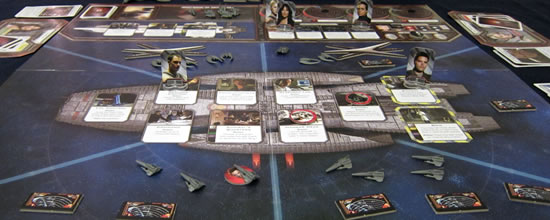
'Battlestar Galactica: The Board Game' Review


Designed by Corey Konieczka, Battlestar Galactica is a game of politics, betrayal and survival. Throughout the game, the humans are on board Battlestar Galactica, trying to protect civilian ships and defending the onslaught of the enemy cylons, while at the same time finding out who are the cylons that are already on board. The problem is: these cylons look just like the humans.

It Oozes Theme
Battlestar Galactica: the TV show is one of my favorite. Upon finishing each episode, I found myself wanting to go on to the following episode, just to see if the humans will survive. While playing the board game, all the great memories of the TV show just flooded through my mind and for the next 4 hours, I found myself immersed in the game as I played Admiral William Adama. Little did I know, I was a sleeper cylon.

Playing With A Group That Has Never Seen The Show
My gaming group that afternoon consisted of 5 other players who have not seen the TV show. Initially, I was worried if they will be able to sustain the long gaming sessions. However, it seems that they enjoyed the game quite a lot that by the end of the game, none of them complained of the length of the game. We did play a few rules incorrectly, but they weren't enough to kill off the game. Looking back at why our gaming experience turned out great, I believe it's a combination of the game elements and the chemistry of the gaming group. Each character plays an important part in the game. Whether it is the Laura Roslin the political leader, or "Chief" Galen Tyrol the engineer, they each have a role to act, and the skills they possess contribute greatly to the survival of Galactica. The players in our gaming group really played the roles as if they were on the ship. Is that because they role-played them well? I doubt it since they did not enjoy Pathfinder. I believe the tension caused by the crisis cards, the roles each character has to fulfill and the difficult decisions they have to make throughout the game infused a great gaming element to it.

Are You A Cylon?
This game introduces to players the concept of backstabbing and betrayal. It implements the role of traitors perfectly. When the time comes to fulfill a certain crisis, every player can choose to play skill cards. 2 destiny cards will also be added to the pile of cards so as to ensure a lower chance of suspecting who may be trying to sabotage the missions. This game mechanic, in my opinion, works wonders. Although The Resistance and Panic Station implements them to a certain degree in their games, the Battlestar Galactica's version works best. Why? Because players are so busy trying to survive the crisis that trying to pin-point who the traitors are become less important. That's not to say that not finding out the cylons are not important. Also, when someone is revealed as a cylon, he or she can still do a whole lot of stuff in the game. I sometimes feel that by revealing themselves to the others, these cylon players actually have a better advantage at winning the game. It is at this time that the humans have to work as one in order to survive. And this really reflects the great moments of the TV series.

How To Approach The Game?
The game is best approached by players who are looking for a fun thematic experience and do not mind longer than usual gaming hours (our first sessions with six players took around 4 hours). At its core, Battlestar Galactica does not have a deep game mechanic. It can be broken down into (1) draw your character's skill cards, (2) move to a location on the board and do an action of the player's choice, and then (3) draw a crisis card and resolve whatever's written on it (most of which are usually not so good). If you are looking for some form of deep strategy to win the game, then you'll be completely disappointed. What it makes up with is the strong interaction between the players. This is where the game succeeds amazingly.

The Game Is Long...
But our gaming group did not mind the length, and that testifies to the greatness of the game. I admit I was worried a few times during the game since my gaming group did not experience the TV show. However, they all testified that Battlestar Galactica is better than Panic Station and Resistance, both of which are brought out onto the table on a weekly basis. The reason, I believe, is because this game brings the best experience of betrayal and survival. The length of the game just deepens the players' bond with Galactica and their characters. And trying to survive the last jump when the cylons are doing everything they can to destroy humanity's last hope, that climatic experience will probably be etched into the minds of our gaming group for years to come.

Conclusion
If you like games that involve lots of player interaction, you should at least try this game. If you are into thematic games, you have to try this game. And if you like games that involves survival, betrayal, politics and theme, you owe yourself to buy this game. If not, find someone who has it and ask persuade them to let you play the game with them. As for me, Battlestar Galactica is currently my favorite board game.

Overall: A+